
Extreme Rock (2nd Edition)
- Thursday 26th February 2026
By Grant Farquhar
Vertebrate Publishing £45
Review by Keith Sharples
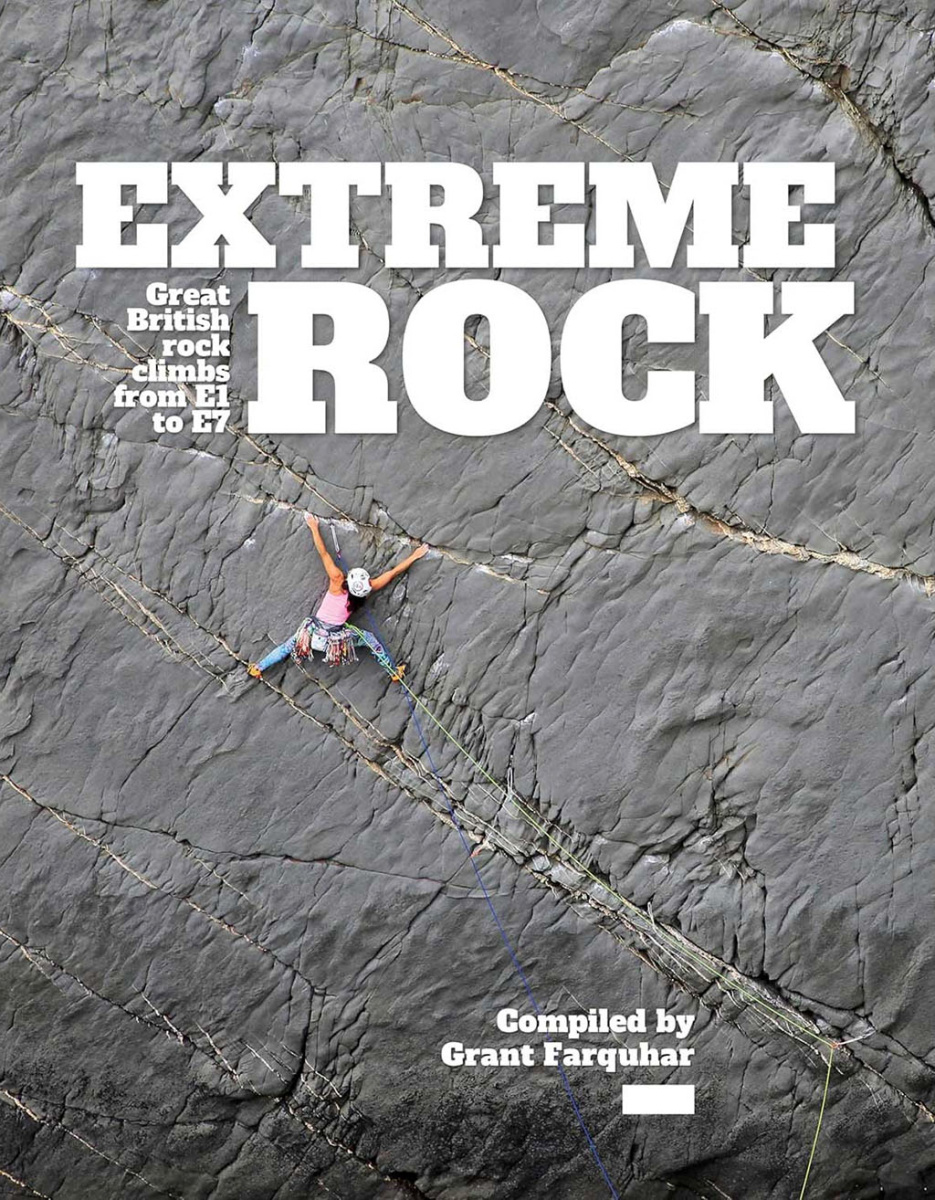 Preceded by Hard Rock and Classic Rock, Extreme Rock was the third in a trilogy of coffee-table books published by Ken Wilson’s Diadem (and others) which unashamedly celebrated the very best of ‘Great British’ rock-climbing. At the time Extreme Rock was published British climbing was – no pun intended ‒ standing on the edge of a precipice. Climbing standards across Britain were accelerating at a remarkable rate – thanks in part to the unintentional consequences of the Thatcher government’s introduction of the Enterprise Allowance in the early 80s! Traditional climbing i.e. that protected predominantly by leader-placed equipment – was reaching untold heights of both difficulty and seriousness. Running parallel to hard trad climbing a different style of climbing, imported from Europe’s hot-spots and protected predominantly by in situ expansion bolts, had emerged and was rising rapidly in popularity and spreading. It too was responsible for driving standards to unprecedented levels. The two fundamentally disparate styles of climbing didn’t sit well together in the eyes of some climbers and the rapid rise of sport climbing – as the newbie on the block was called – was seemingly threatening the very existence of traditional climbing and the ethical basis upon which that was based. However, recognising both styles of climbing that then existed, Extreme Rock was published in 1987.
That Extreme Rock was born as sport climbing emerged onto the British scene was an unintended consequence of the lead time taken with the writing, photographing and creation of a manuscript for the then hardest climbing routes in the country. Whilst containing predominantly trad climbs, Extreme Rock – as a representation of the then ‘cutting edge’ – also contained a fair number of bolt-protected sport climbs. Whilst Hard Rock and Classic Rock celebrated routes that many climbers could aspire to do, Extreme Rock ‒ by dint of concentrating on the hardest routes around ‒ arguably featured routes which were more inspirational. Published against a backdrop of questionable commercial grounds and an uncertain outlook, Extreme Rock not only completed the trilogy but it was a snapshot of the then state of climbing in Britain. Recognising the commercial concern at publication, only half the printed pages were bound and the rest set aside and stored for the future. Subsequently, the second tranche of the printed pages, along with the printing plates themselves, were all lost, the value of the then circulating copies of Extreme Rock escalated considerably – prices as high as £300 or more on the second-hand market weren’t unheard of at the time. Extreme Rock, became ‘the book’ and was cemented into British climbing history.
Fast forward four decades and, as with Classic Rock and Hard Rock, now at last we have the second edition of Extreme Rock. All are published by Vertebrate Publishing, the Sheffield-based power-house which bought Ken Wilson’s then interest before his passing some years ago. Rightly, the editor of the new edition, Grant Farquhar, recognises in his 2025 Postscript that ‘a lot has changed’ in British climbing over the intervening years. He is not wrong! It’s clearly beyond the brief of this review to clarify or illuminate on those changes per se. Farquhar, however, has rightly reflected long and hard on said changes and, no doubt along with the publishers thinking on additional possible downstream titles, has accordingly made some changes to the line-up from the routes presented in the first edition of Extreme Rock. Both Farquhar and Vertebrate are at pains to note that the second edition is in no way intended as a replacement book but rather they have tried to publish a new version for a new millennium. Some of the old routes have been dropped and replaced by new routes for which new essays have been written and photographed by new contributors. Ironically, the second edition opens with an essay featuring three amazing new routes climbed just as the first edition first hit the shelves. Alongside these new chapters, new photographs and new writing illustrate some of the old routes. Collectively, the second edition of Extreme Rock ‘celebrates the best of British rock-climbing’ in the grade range from E1 to E7.
As a climber active during the 80s when the first edition of Extreme Rock was published I have to declare that I have long been inspired by the routes, the writing and the photography of the climbing portrayed in that edition and ascents of routes therein have been cherished. A central question then is how does the second edition measure up and will it become the seminal title that the first edition has become?
Some facts then re the second edition. Firstly, the second edition is physically bigger, an inch – sorry, 2.5cm – taller and wider, bigger in fact than A4-sized and as such the new book has some serious real estate upon which to showcase the routes within the covers. Let’s turn to the page count next and here the direction of travel is south. Sadly, the second edition page count is 252 – down from 298 in the original. The number of routes is also down in the second edition, down from 180 in the first edition to 154 routes. Finally, and perhaps most visually striking of all, are the photography metrics, overall, the number of photographs is down from 298 in the original edition to 136 i.e. less than half. Looking at the total number of photos though doesn’t convey the full story; the number of full-page photos – including both full bleed and those with margins – actually increases from 55 in the original to 73 in the latest edition, a substantial increase.
Let’s dive down a little further into the weeds to explore the new edition – and the differences between it and the first ‒ in a little more detail. Starting with the layout, the publisher has given the second edition a thorough modernisation. With very few exceptions, the original layout was ‘full to the brim’ i.e. every bit of every page had a photo, text or a route line diagram on it. Viewed though the modern lens of ‘less is more’ the old layout is undoubtedly very busy visually. The latest edition is not only more generous with the depths of the headers and footers but the designer hasn’t been afraid of leaving white space on the page where previously another photo would have been included. Which layout you prefer is down to taste but the latest edition looks fresh and modern to the reviewer. Previously, the text was arranged in a three-column layout, now it’s a two-column layout with a 2/3rd and 1/3rd width. As per the photos, the new text layout has a less cluttered appearance. Overall, the layout of the second edition makes for a more relaxed and stately appearance.
Returning to the photographic coverage it’s clear that the publisher has given a very strong preference to full page illustrations, in fact, almost every separate chapter starts with a full-page photo, numerous smaller and more incidental images have been consigned to the editing floor. The photos included are a mix of old and new, with very few exceptions, the quality of photography and reproduction is excellent. Generally, it’s relatively easy to spot which are the old or the new photos. As you’d expect climbing photography has also matured in the c.40 years since the first edition was published.
Let’s turn to the route selection itself then. Many who have grown up with the first edition will have an opinion on this and some will be more controversial than others. Three main aspects, however, seem to merit discussion: the distribution of routes within the various climbing areas; the deletion of old routes and the new routes added. Firstly then, let’s look into the various areas featured around the country. Starting in the north, Scotland has 35 routes featured in 14 separate chapters; the first edition featured 39 routes in 15 chapters. The route/chapter count for both the Lakes and the Dales is broadly the same but North Wales now has 25 routes arranged in 10 chapters significantly less than previously when 38 routes in 18 chapters were included. The Peak though has seen the biggest cuts in its coverage; 17 routes in six chapters is a considerable step-down from 30 routes in 11 chapters! The graceful winner in this numbers game, however, is undoubtedly Northumberland, The County, as it’s colloquially known, makes its first appearance with four routes in two chapters – a very welcome newcomer to the party. Completing the round-up, Pembroke and the South West of England has seen a very slight increase; collectively that now has 36 routes in 15 chapters up from 35 routes in 14 chapters.
Any in-depth discussion on the routes deleted and the new ones added would take the review way over a reasonable word count, it is nevertheless, worth pulling in the trends. As editor Grant Farquher talks us through the spirit of the route changes between the two editions describing them as ‘fairly radical’. At the head of the list of routes deleted are the sport routes – most of which were in the Pennines and North Wales; these have been ‘bumped’ off the list pending possible publication of a new title downstream ‒ Sport Rock. The Indian Face, the mega frightener on Cloggy in the original, has also been bumped out, an E9 that is heading for publication in Ultimate Rock. Some routes, such as Tyrannosaurus Rex, have suffered rockfall and hence dropped from the list. Others have been dropped either because they haven’t proved popular and/or because new routes have been added which are considered ‘better’.
Although such changes seem, on the face of it, very reasonable and justified, there will be some readers – the reviewer included – that will undoubtedly lament the passing of some of the routes, not least for their historical significance. For example, Footless Crow in the Lakes; Winking Crack, The Strand, Dinosaur, Mammoth and Citadel on Gogarth as well as the Great Walls on Cloggy and Craig-y-Forwyn. In the Peak, the list of deletions runs savagely deep. In addition to Millstone’s White Wall and Great Arête, the tour-de-forces at both Stoney Middleton and Cratcliffe are no more. Of the eight routes at Stoney and Cratcliffe consigned to the editing floor, a minute’s silence must surely be observed collectively for Circe, Bitter Fingers, Wee Doris, and Our Father as well as Fern Hill, Five Finger Exercise and Requiem? The addition of The Golden Mile at Chee Tor along with the four Northumberland routes – The Tube, On the Rocks, Northumberland Wall and Endless Flight ‒ help ease the pain somewhat as well as a fine trilogy at Malham – Wombat, Slender Loris and Doubting Thomas – but the cuts still hurt!
Finally, then, a few thoughts about the writing and photographs in the second edition, a sizeable number of which have been retained from the original edition. As per that, the writers have injected personal anecdotes alongside factual descriptions of climbing the various routes as well as historical context; it’s a blend of writing that is both informative and inspirational. Photographic coverage is more modern and bespoke ‒ thanks to the efforts of a number of photographers who have clearly accompanied the climbers specifically for the purpose of capturing modern imagery. It’s because of the efforts of the dedicated few that the number of mediocre shots is absolutely at a minimum; ditto the classic ‘grab shots from the belay/ground’ are likewise limited. A book like Extreme Rock wouldn’t exist if it wasn’t for the collective efforts of all the contributors; the readers owe a hearty thanks. Two especially caught the eye ‒ Mike Hutton and Ferdia Earle. Amongst the photographers – all of whom have offered a piece of themselves and shared some of their best work on the project ‒ Mike especially should be thanked for sharing from his extensive photographic coverage across the entire country. Likewise, all the wordsmith’s new and old bring their stories about the routes they’ve climbed to life for our edification – in addition to details about the route she’s writing about Ferdia’s writing seems to have a depth and richness that is especially engaging, painting, as she does, about how life and climbing go inextricably together.
Let’s try and bring this to a close then. Everyone involved should be commended for their toils. Collectively they have – as the publisher suggests in the introduction – produced not a replacement for the original edition of Extreme Rock but an edition for the new millennium. For those taking a second slice of the Extreme Rock pie, many will find the second edition modern and refreshing, there will undoubtedly be those that feel queasy at some of the changes, that, however, is inevitable in the circumstances and a reflection in a way of just how much the first edition became the seminal title that it did. A lot has changed, however, in both our sport and in the publishing world since 1987 and things move on. For those who are new to either climbing and/or to Extreme Rock, the second edition will surely appear a thoroughly modern, wholesome and deeply engaging addition. The writing, photography and route selection fit for the new millennium and will undoubtedly prove very popular. We can only look forward to the summer and dry rock to sample some of the new delights and, of course, to the publication of further titles in the series, Ultimate Rock and Sport Rock, further celebrations of Great British climbing.